


Case studyLMS EXRepublic of Korea2014
Laser methane monitoring on LNG storage tanks in Korea
In 2014 Korea Gas Safety Corporation began the newly mandatory precision safety diagnosis of LNG storage tanks. Pergam built LMS for the work: an explosion-protected version of its DLS-KS laser methane scanner. Mounted on the tank roof, it watched the roof and the area around the tank for methane during each diagnosis.
- Client
- Korea Gas Safety Corporation (KGS), the designated diagnosis body for LNG storage tanks
- Site
- A KOGAS LNG receiving terminal near Seoul
- Equipment
- LMS EX: explosion-protected Laser Methane Scanner on a new pan-tilt unit
- Delivered
- Installed by the end of August 2014, commissioned in September 2014
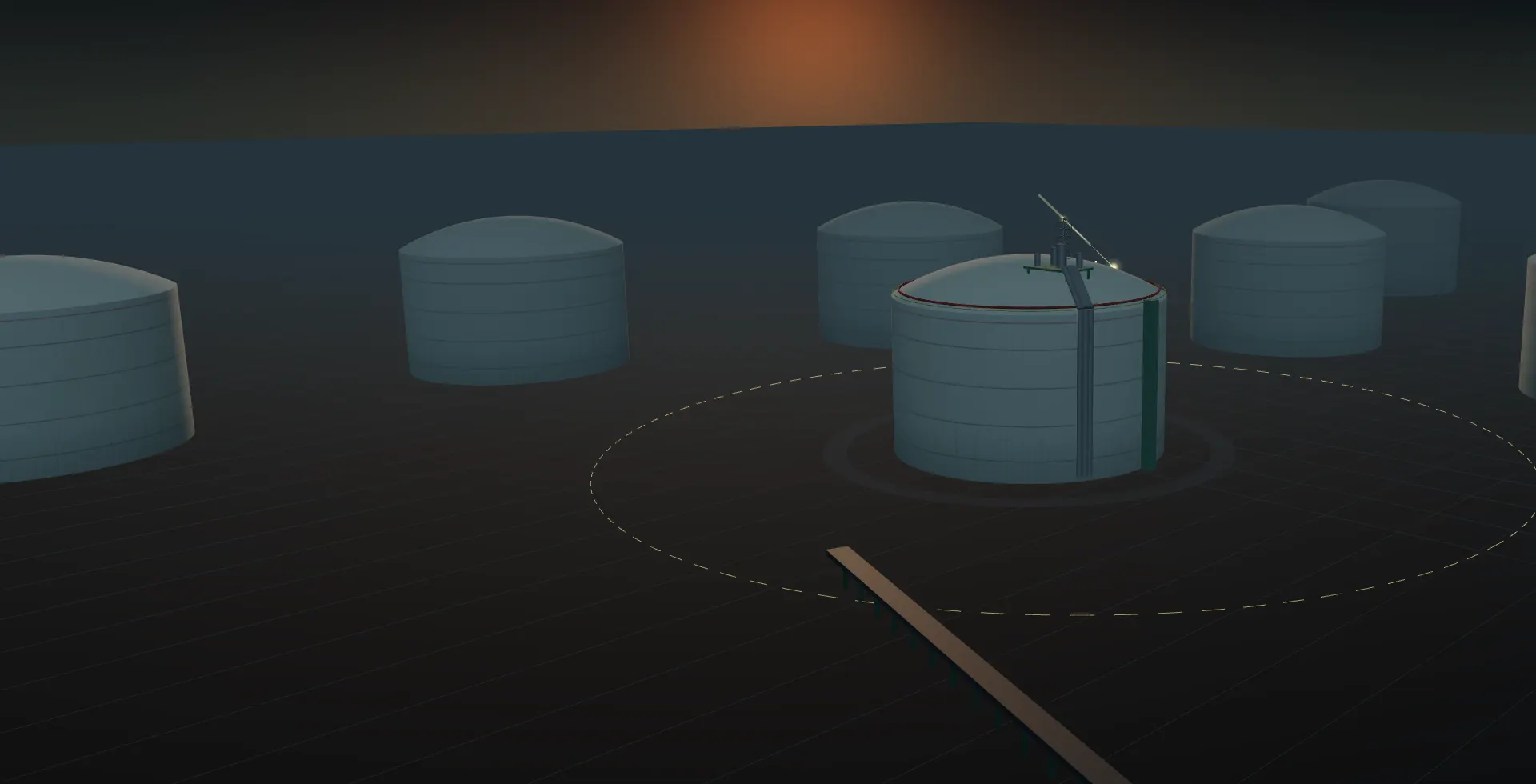
3D reconstruction of a scanner on an LNG tank roof. Proportions approximate; the beam is drawn for clarity.
Key figures of the 2014 system
- 150 mmaximum distance at which the LMS used by KGS detects a small methane leak
- 0.2 sto detect that leak at the same distance
- 360°in azimuth and about 40° up and down, so one scanner on the roof covers the roof and the area around the tank
- 1 weekof LMS monitoring per tank, the first step of each KGS diagnosis
Figures for the 2014 system as reported by Gas News on 20 November 2014. Current LMS models have different specifications.
The project in 36 seconds
The diagnosis, the scanner on the roof, the measuring principle and the delivery timeline, reconstructed from the published sources.
The task
A new inspection for LNG storage tanks
In August 2013 Korea amended its Urban Gas Business Act, and from 2014 LNG storage tanks need a precision safety diagnosis. Under the rules drafted in 2013, the first falls within five years of a tank's completion inspection; from 15 years after it, the diagnosis repeats every five years. Korea Gas Safety Corporation (KGS) was named the diagnosis body. It set up a storage tank diagnosis department and bought new equipment for the work.
The tanks are large structures: on this terminal about 60 m high and 80 m in diameter. Pipework, valves and platforms are grouped on one side of the roof. The aim was one instrument that could watch the whole roof, including that pipework, and the area around the tank for methane, through the week a tank is under diagnosis.
How KGS diagnosed a tank in 2014
- 1
Leak monitoring
LMS is installed on the tank roof and watches the tank and its surroundings for methane for one week.
- 2
Outer concrete
The outer concrete is checked for cracks and damage. Where a problem is found, high-resolution scanning resolves cracks down to 0.1 mm.
- 3
Walls and bottom
A thermal camera looks for temperature differences on the walls and bottom that could indicate methane. Suspect areas are checked with a suction-type detector.
Source: Gas News, 20 November 2014. Diagnosing one tank took about a week and was not done in midsummer or midwinter.

The engineering
An explosion-protected LMS on a new pan-tilt unit
The starting point was DLS-KS, Pergam's stationary laser methane scanner for open process areas. The first DLS-KS was commissioned in March 2013 at a compressor shop of Gazprom transgaz Ufa. The system had passed Gazprom's acceptance tests and was recommended for use at the company's industrial sites.
For KGS, Pergam engineers reworked both the design and the operating concept of DLS-KS to the customer's technical specification. The result was LMS: in essence an explosion-protected version of DLS-KS on a completely new pan-tilt unit. Pergam's reference list calls it LMS EX.
Before the order, Pergam engineers met KGS and visited the terminal with its staff to choose the mounting point on a tank roof. At the presentation on site they showed a 3D plastic model of the optical unit and pan-tilt head.


- 1 Housing with a bolted window and protective grille. Behind it: the video camera module.
- 2 Second housing, with the laser measuring optics.
- 3 Pan-tilt head. Published in 2014: 360° in azimuth, about 40° up and down.
- 4 Sun shields over both housings.
- 5 Ribbed housing walls.
- 6 Cable connections at the base.
- 7 Mounting flange of the pan-tilt head. On site the unit stood on a steel stand at the top of the roof tower.
The 2014 system, as documented
| Item | 2014 data | Source |
|---|---|---|
| Base system | DLS-KS, in service at Gazprom transgaz Ufa since March 2013 | Pergam reference list |
| Version | Explosion-protected version of DLS-KS on a new pan-tilt unit, as described by Pergam in 2014. Certification details are not published here. | Pergam news, 19 Dec 2014 |
| Coverage | 360° in azimuth, about 40° up and down | Gas News, 20 Nov 2014 |
| Detection | A small methane leak at up to 150 m, in 0.2 s | Gas News, 20 Nov 2014 |
| Measuring principle | Laser absorption at 1.65 µm; result in ppm·m | Pergam presentation for KOGAS, undated draft |
| Calibration | Built-in methane reference cell; automatic calibration at start-up and during operation | Pergam presentation for KOGAS, undated draft |
| Video | Camera in the optical unit shows the operator where the beam points | Pergam presentation for KOGAS, undated draft |
| On site | On a steel stand at the top of a scaffold tower on the tank roof | Site photographs |
Only data stated for the 2014 system are listed. Current LMS models have different specifications: see the LMS product page.
The method
How LMS measures methane from a distance
LMS sends an infrared laser beam at 1.65 µm, a wavelength that methane absorbs. The beam hits a surface: the roof, a pipe or the ground. Part of the light scatters back to the optical unit, which compares it with a reference channel and works out how much light methane absorbed on the way.
The result is the amount of methane along the whole beam path, in ppm·m: concentration multiplied by the length of gas the beam crossed. 100 ppm over 1 m and 10,000 ppm over 1 cm both read 100 ppm·m. A reading says how much methane the beam crossed, not where along the path it was.
The pan-tilt head steps the beam along a programmed route, so the scanner covers the roof and its surroundings point by point. The video camera shows the operator where the beam points. A methane cell inside the unit is the reference for calibration and self-checks.
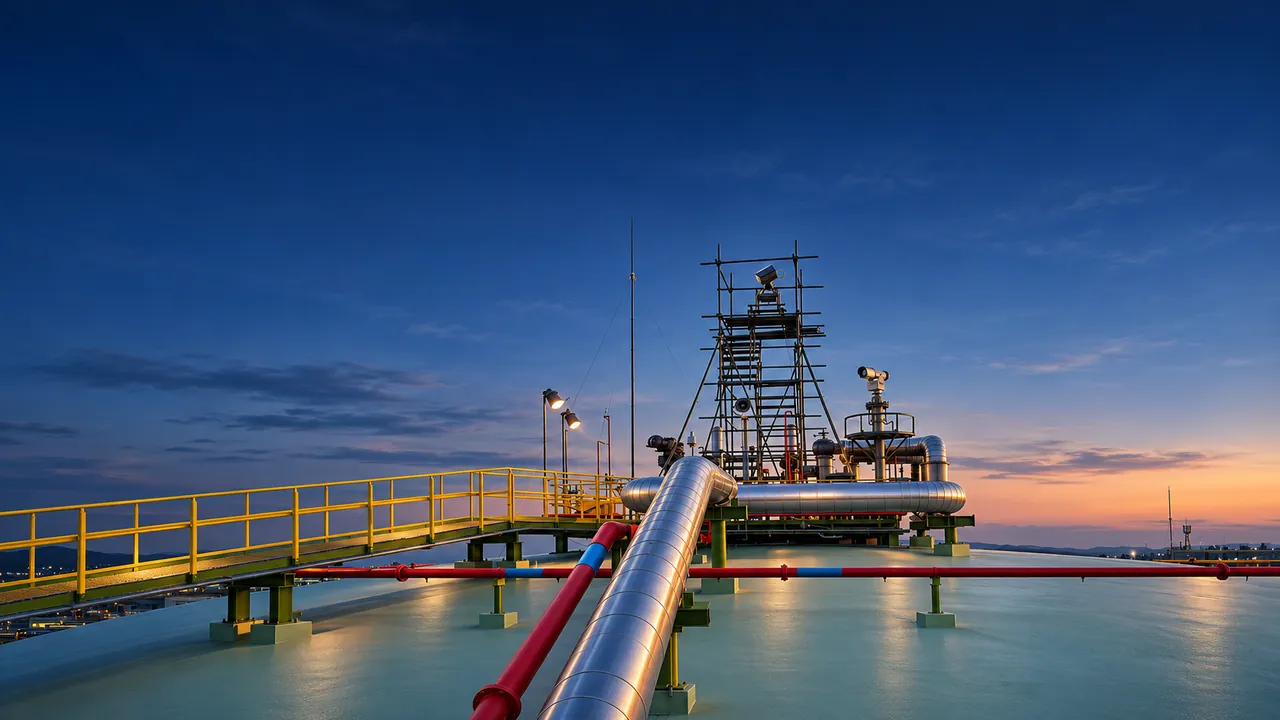
One scanner at the top of the roof tower, the tank roof all around it.
The system
From the optical unit to the operator
In the site photographs the optical unit sits on a welded steel stand at the top of the roof tower, with a field enclosure strapped below it. The operator works at a PC with the LMS software.
Monitoring
Live view of the scan with video; alarms when methane is detected.
Control
Scan routes programmed for the specific areas to cover.
Records
Data and video archive for the whole period of operation; log of operator actions.
Output
Leak data, including size and location, exported as text; a report in Word format with one button.
Software functions as offered in Pergam's presentation for KOGAS (undated draft); the delivered configuration is not documented.
The project
From the roof visit to commissioning
- Before the order
Technical specification
KGS sets the requirements for the system.
- Before the order
Site visit
Meeting with KGS. On the terminal, Pergam and the customer choose the mounting point on a tank roof.
- 2014
Engineering
DLS-KS is redesigned into LMS: an explosion-protected version on a new pan-tilt unit.
- End of August 2014
Delivery and installation
Pergam completes delivery and installation of the system.
- September 2014
Commissioning
The first LMS EX goes into service on the KOGAS LNG terminal.
- November 2014
In use
By 20 November 2014 KGS had completed the diagnosis of seven LNG tanks, out of 13 planned in total by the end of 2015.

After 2014
- Sep 20152 more LMS EX units for the KOGAS LNG terminal
- May 20162 units
- Dec 2018First unit repaired: metal parts and cables replaced
- Dec 20191 unit
- Jul 20201 unit
7 LMS EX units for the KOGAS LNG terminal between 2014 and 2020, according to Pergam's reference list.
The record
What is documented
Supplied
An automatic laser methane monitoring system: the explosion-protected LMS optical unit on its pan-tilt head, with operator software.
Engineered
DLS-KS redesigned to the customer's specification: explosion-protected version, new pan-tilt unit, mounting at the top of a tower on the tank roof.
Confirmed
Installed by the end of August 2014, commissioned in September 2014. Used as the first step of the KGS diagnosis, one week per tank. Gas News reported KGS as the first organisation in Korea to introduce this kind of equipment.
Not yet published
Number of tanks monitored with LMS since 2014; detections and what followed; availability and maintenance record; experience in summer and winter. To be added with the customer's approval.
In the past we had to locate cracked areas by hand, one by one. The LMS, an advanced monitoring device, has made wide-ranging inspection possible.
This case describes the 2014 system and its use by KGS as published at the time. It reports no measured leak data and no operating statistics: none have been published.
About the client
Korea Gas Safety Corporation
Korea Gas Safety Corporation (KGS) is Korea's specialist public agency for gas safety. It was founded in 1974 as the High-Pressure Gas Safety Institute and took its present name in 1979. KGS inspects, certifies and diagnoses gas facilities across the country and is the designated body for the precision safety diagnosis of LNG storage tanks.
- In this case
- Precision safety diagnosis of LNG storage tanks, with LMS as the leak monitor
- Pergam equipment
- LMS EX, supplied in 2014
- Based in
- Chungbuk Innovation City, Republic of Korea
Photographs
On the terminal and in the studio
Each label says what the image is. Documentary photos have levels and sharpness adjusted, nothing else. Retouched and reworked images say what was changed. Open any image to compare it with the original file.
Sources
- Gas News (가스신문), report on the precision safety diagnosis of LNG storage tanks, 20 November 2014. In Korean.
- Gas News, precision safety diagnosis of LNG storage tanks to be introduced, 30 September 2013. In Korean.
- Pergam, project completed on the Asian market, 19 December 2014. In Russian; it names the customer “KOGAS Safety”, meaning Korea Gas Safety Corporation.
- Pergam Group, LMS and LMS EX reference list, 2025.
- Notice on the procedure and methods of precision safety diagnosis of LNG terminals and LNG storage tanks, Art. 3(6), version in force since 5 April 2023. In Korean.
- Pergam-Suisse AG, LMS-Remote presentation prepared for KOGAS, undated draft.
- KGS, About KGS: History.
Labels on images: Documentary photo and Studio photo are photographs; Retouched and Reworked images are based on them and say what was changed; Reconstruction and Schematic mark drawings and animations made for this page.
Planning methane monitoring for tanks or process areas?
We can discuss scanner choice, mounting point and scan routes for your site.
Or write to info@pergamitaly.eu
For hazardous areas, the current stationary line includes LMS mini, listed with ATEX, IECEx and KCs certification on the product page. The current LMS comes in a standard enclosure.
Credits
Client: Korea Gas Safety Corporation (KGS).
Site: a KOGAS LNG receiving terminal.
Equipment, engineering and installation: Pergam.
Photographs and retouching: Pergam. 3D scene, drawings and film: reconstructions made for this page.
Using Pergam equipment in the field? We publish client case studies with a link to the client's website. Write to info@pergamitaly.eu.
Also read: Drone survey of methane emissions at a gas compression station
We Invent to Prevent.